
THE TREE OF UNDERSTANDING
A PEEK INTO A WAY TO BREAK DONW THE CHALLENGE OF BEING HUMAN.
I would to like to make it clear that there is no prerequisite to living a rewarding life that requires us to have any complex or excessively deep language for dissecting the ebb and flow of existence. However, as I often mention, we often find our selves looking for languages, for interpretations that can speak most accurately to how we experience and understand life, or how we would wish to. This is whole point of this particular tree. It is to create a cohesive context for the various elements of our life. Like many things, we can ponder it, let it speak to us as seems fit, and then toss it aside and see what, if anything, sticks with us in terms having value and helping us to nourish a healthy view of things.
What do you do with this tree? Use it to recognize and empower the reality that we have more than one world that we are in the school of life to learn about and bring wisdom to. Eventually, they all meet. Our lives are the sum total of all three branches, and the healthier the branches are the less likely they will seem to be at war with each other and the more they find some balance together. So much of life is about permission, permission to feel and see things for what they are. So much of our wows are our internal battles and conflicts with things that are just what they happen to be in spite of what we are told they are or want them to be. Our lives can be wonderful things, but our challenges are truly endless, many of them daunting at certain times in our lives. It is important to see and recognize the gravity and the vast landscape we are dealing with when we are trying to evolve in our relationship to life. This is so we can give ourselves and others the much needed forgiveness for the times we, or they, happen to trip up in life. We need patience and we need buckets of positive energy. And we need to make sure we are falling and getting up to learn, strengthen, and move forward, not just to hone our ability to fall over and over again, puppets to our weaknesses.
It is difficult to impossible to prioritize any one branch over the other, although we often need to prioritize one more than the other in different phases of our life. Emotion may be our hardest test, but energy/spirit and healthy expressions do wonders to help us balance the transient and lucid world of our inner emotions. We all instinctively know our weaknesses, what parts of our trees need the most attention. And yes, sometimes it seems like our whole tree is screaming out to us, we feel like a mess, and that is when we need to focus on our center, not all the branches, but that person who sitting in the middle of the branches. We need to get simple again, and we need to find strength and purpose, vision, and listen for where to begin. I always recommend starting at the top. Spirit, energy, leads to clarity and vision and it is those things that can shake the branches from which we need to focus our work of the time.
Let's begin this journey into our school of life learning by identifying the 3 types of knowledge, as this particular tree represents the first form.
PRIMARY KNOWLEDGE
How I love making up new terms for things. It just feels so....special. It doesn't really matter what you call this. This is what we often learn in any academic environment. It is knowledge that goes into our library of information. We use it as a reference, maybe we toss it aside, maybe we apply it a little to a hypothetical situation. Regardless, it is meant to give us a foundation of how to percieve and engage with whatever it is that we intend to apply our learning to. This is a place where we can get as deep as we choose to. We can contemplate, challenge, or reinterpret a given lesson at our discretion. It is not uncommon with this type of knowledge that we often absorb a lot of information that may not have any use to us at the current moment. We are, to some degree, just building a language for interpretation.
MOMENTARY KNOWLEDGE
Arguably the most powerful form of knowledge for which I will explain. Momentary knowledge is what we must discover to solve or have a clear vision of a current challenge at hand. The power of this knowledge is that it binds to an experience which is what gives us our greatest wisdom, not just our library of information. We can go to school for years, but it is out in the world solving challenges as they arise that give us our most powerful knowledge. In fact, there are many wise people who forego any obsession with primary knowledge in order to head straight to the meat and potatoes of momentary learning. These are the high school drop outs who build successful businesses, of which there are many, and the monks who leave everything behind to stare at trees and dew drops and watch the nature of things from the inside out.
DISPENSIBLE KNOWLEDGE
It would be both foolish and short sited to not acknowledge that which exists but does not serve us. In our modern worlds, we are bombarded with dispensable knowledge. Who wrote the song "Love plus one?" Haircut 100. I know that. Why? I don't know. Who is the 16th president of the United States? Not sure. I would have to look that up. Why do I not know that? Not sure. One of the things about our modern desire to worship our brains as the center of our universe is to cram them full of things as a testimony to their greatness. That is to test the limits of what they can absorb, which is not all that different from how we just throw things in our bellies to see what they can digest. The price of an overtaxed or abused belly can be anything from an upset stomach to some very nasty health issues. The price of an overtaxed or abused brain is memory loss, a struggle to think clearly and process information, and this can eventually lead to, or accelerate some very nasty brain disorders. There is nothing wrong with a piece of cake or a glass of wine every now and then. And there is nothing wrong with a certain degree of meaningless, purposeless information floating around in our heads. In fact, many of us have jobs in which that is what we get paid to manage. However, there is a breaking point to all things and that is when we are operating on dispensable knowledge, when it becomes the fabric of how we live and perceive life. This is far too easy to do these days as everyone wants a piece of our attention to stuff something in it. Truthfully, I am vying for your attention as well. I just hope I am doing so with your well being in mind. In our lives, in our modern worlds, we need to increasingly de-emphasize the role this knowledge plays in our lives. This leaves us at times feeling a bit empty and more sensitized. Exactly the place to truly begin to understand life.
Now, on to our Tree of Understanding and the 3 primary branches Spirit, Emotion, and Expression, each with their secondary branches.
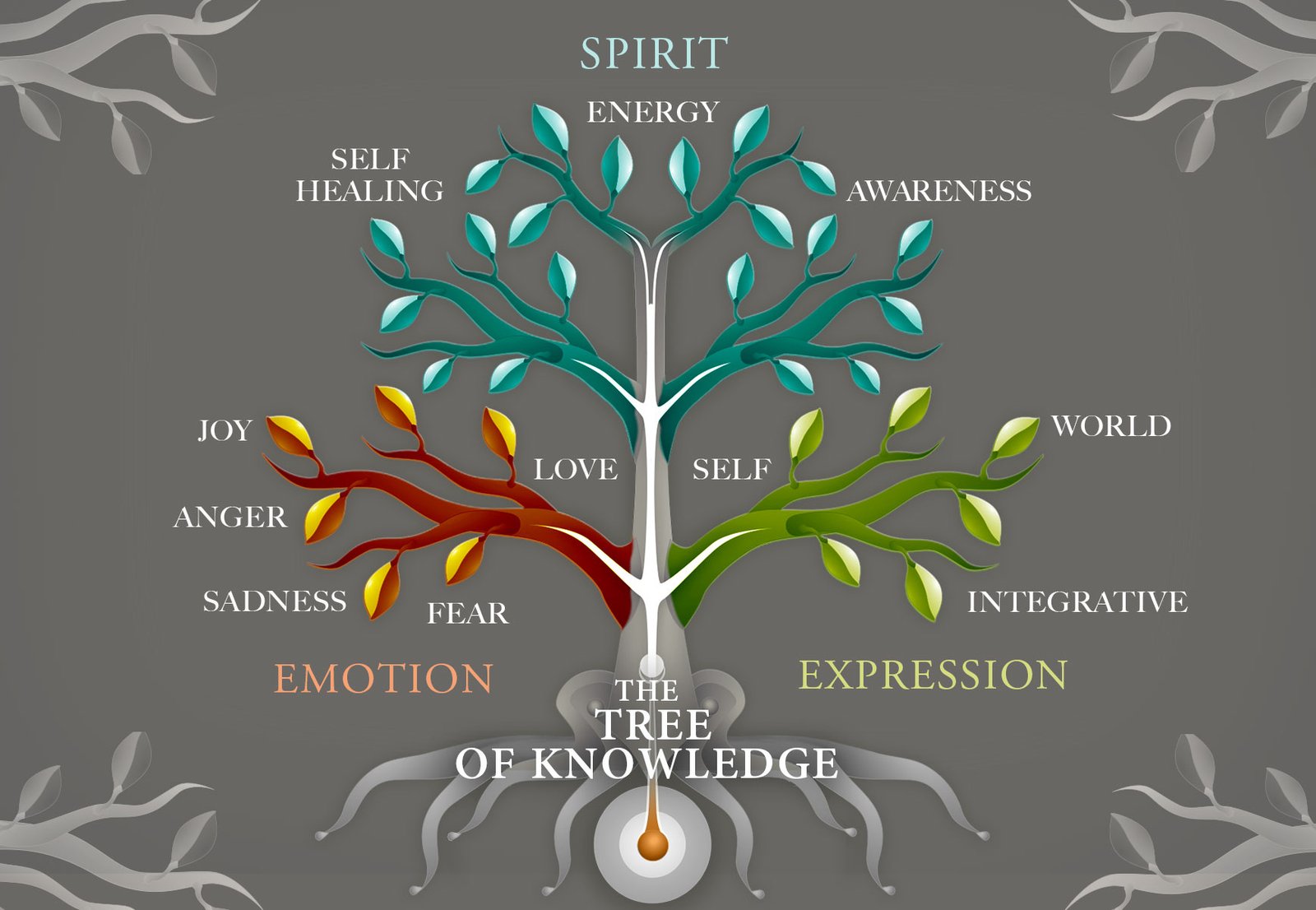
SPIRIT
Our first of the three major branches deals with our relationship to energy. It holds our relationship to conscioussness, our clarity, our wisdom, and our ability to interpret and manage the energy in and around us. This is the realm of our higher relationship to our intangible world what could be called our higher mind. I have given this realm 3 secondary branches, Awareness, Energy, Self Healing.
AWARENESS
Awareness is perhaps what ties us most closely to our self evolution. It is not easy to be aware, completely aware. Being completely aware does not allow for delusions, things that most of us carry with us through a good portion of our lives. True awareness hides nothing and that is a scary place that few of us are prepared to go to. It is often only when we fully realize the price we pay for living in a given delusion that we dare to allow ourselves to evolve beyond that delusion into some form of awareness. Pure awareness is an empty place that wants and needs for nothing. Wisdom is the seed of awareness because true wisdom comes from a place of fearlessness.
ENERGY
This is our understanding of what could be called our non-physical “fuel” for life in its purest form. The common terms are Chi, Prana, or Life Force. Energy is like gas in the tank. It has no concern as to how it is used. That is something we need to embrace about energy. It is just there if we take the time to foster it. So, it is really a matter of how we move and channel energy that defines whether it is a positive or negative thing and whether we are in harmony or conflict with our expression. This is a life long practice that must also adapt to matters at hand, not to mention the reality that the positive and negative forces of life all have their time and place. The answer to this lofty part of our tree does not come in a paragraph. Creating and maintaining energy is our highest and most important skill. It is ultimately energy that guides us, heals us, protects us, and gives us value in our communities when we understand how to express that energy wisely. Wisely managing and expressing our energy is our most rewarding pursuit along with the pursuit of understanding love and hence, will always be our most challenging.
SELF HEALING
We injure and we break. It’s what things do. All things, including us. It sucks. It’s not something anyone would sign up for if they could opt out. The good news is that, at least to a certain degree, we are wired to heal. We have evolved through injury, and there are few things in nature that do not have some form of impressive self healing capacity, even lakes and streams. Understanding our capacity to self heal and to optimize that component of our nature is one half step down from our grander goal of energy management. There are forms of self healing that happen quickly and feel joyful and miraculous, and then there are others that feel like we are being dragged through a most miserable hell. There are times when healing only comes through intense pain and wisdom is not enough to master this part of our life. Can we open the door and accept a possible miraculous and necessary healing? Can our spirit make it to the other side of a painful healing? Do we know the difference between an uncomfortable healing process and a self destructive pattern? Hmmm.
EMOTION
If spirit represents our relationship with our higher inner intangible world, then emotion represents our relationship to our lower intangible world. We should never embrace emotions as lofty things. Emotions are not good things or bad things, they are simply things, signals really. It's just that they can be incredibly powerful at times which is why they are diffiuclt things to let go of. And while we are bound to our emotions by virtue of being human, managing them represents much of the work in our life, which is learning to tame the beasts that most of them reveal themselves to be. Why are emotions so strong? Because we would not listen to them if they were not. We would not recognize the weight of what we are dealing without the loud gong of our emotions. Or perhaps we feel that others would not give us the time of day without some powerful display of emotion, which is one of the most common sources of emotional instability. Emotions represent a central part of who we are trying to communicate to our souls in a language that can, at times, defy any description. Our emotional worlds are the ones that require the most dilligence and as loud as the power of our emotions can be, it is only our wisdom that can begin to replace the loud noise of our emotions in favor of wise and clear actions that can resolve what our emotions cannot. I have 3 secondary branches to this amorphous and often reactionary part of our Tree. Love, Natural Emotion and Fabricated Emotion.
LOVE. The Calming Master of Emotion.
It has been said by many that love is a bridge between the light and the dark. It is our most revered and desired emotion and yet it can take a lifetime to truly understand what it is. Love adapts. It has to. This is because life is not a linear thing. Love is not romance. Romance is romance. Love has a lot more work to do. It can’t simply hand us a pair of rose colored glasses and then head elsewhere while we fall asleep at the wheel. That is a short lived love. Much like a fire that burns for a long time, love is destined to have its time when it seems like all that is left is a pile of ashes and a few embers. However, we must remember that embers are valuable things that can start new fires, or rekindle old ones. It could be said that if wisdom and emotion collided the result would be love. But again, life shows us that the thing that offers the greatest reward almost always gives us our greatest challenge. Love is no different. Love is not an end game anymore than is success, but rather a doorway to a lot of work. If we have truly found love, that work will be well worth the time and effort.
Natural Emotion
ANGER
There is absolutely nothing wrong with anger, even intense rage at times. We have far too many reasons to be angry about things, legitimate reasons. Anger is a reaction to an external conflict (past or present) and in many cases it is a reaction to an inability to have a desired effect on a given situation, at least to our perception. Anger must become our teacher not our puppet master. Life is full of injustice, of imbalance, of unfairness, not to mention all the people who are hustling to get in advantageous positions at the expense of others. Life is also full of selfishness, if not the selfishness of others, the selfishness of ourselves. Mastering anger takes us through all of these realities and asks us, at the end of the day, how is our anger serving us? It is taking away our life. What can we do to get that life back?
SADNESS
I refer to sadness as the sister of anger because sadness seeks to purge what anger seeks to battle. They are both reactions to suffering, to conflict, to the things we wished we could change or control. Sadness is sometimes the only solution to a given issue. That is to say purging the emotion of conflict and moving on. This is why many women are much more emotionally resilient than men in the long run. What appears to be emotional weakness at first glance turns out to be a lack of conflict with a natural process. Of course, there is an imbalance to all things which is why we can get lost in our sadness and emotional nature, and then we can become self righteous about our need to purge our emotions in the same we can do so in our relation to anger. Do we know what is healthy sadness? What is fair to our natural process of purging and what is simply a lazy and selfish affair with our emotions? Hmmm.
FEAR
Some may not consider fear to be an emotion, perhaps a reaction, but anything that has the capacity to stir our inner worlds, to affect the way we think, act and make decisions is certainly an emotion. Our relation to fear represents our masters degree in life. To be fearless in the face of all things is a trait only the few truly possess even though many would like to think they have a place in that club. That is until something truly worth fearing lands on their lap. No one is immune to fear. Fear is hard wired to our survival instincts. Our fears, until we understand them, are often like a big ball of yarn, a twisted mix of things we have reason to be concerned for wound up with all the things we simply are wasting our energy fearing. At the center of this ball of yarn is freedom. Not freedom from life, work, responsibility, or death, but freedom from fear. There is simply nothing that can rob us of more energy, nothing that can cost us more of our time, our life, even our potential wealth than fear.
JOY
Joy, as we all know, is an emotion. Emotions come and go. They have their reasons and serve their purpose. Joy is not, nor is it meant to be, a permanent state. Any spiritual yahoo that tries to sell you on achieving everylasting joy is not doing you a service. They are handing you a potential poison to your own wisdom. Joy comes and goes. It is to be savored, but never held on to because that won't keep it around. Joy takes us upward, it elevates our state of being and it reminds us of the reason to be alive, to be thankful for this beautiful mess we are in. Joy often appears out of the blue, as our deepest joy oftens follows the cycles of life which can have little to do with anything we have strived for. We can be very joyful for no reason at all. Mastery of emotion, at least a strategy to do so, asks that we bring joy down to a level at which we can use it to prolong the existence of our positive state of being. Euphoria is joy on overload, and euphoria always comes crashing down. Contentment is our ultimate place in life. If we can let our joy settle into a state of contentment, then we do not have to worry so much about the rollercoaster ride that joy can set us on.. Speaking to joy can lead us into this issue of language, because often when Eastern teachers speak to joy, they are simply referring to a healthy state of being, not necessarily the elated feeling that we often associate with joy. Joy is something we should let come and go in its time and place. The focus of our work in life is much better applied to our healthy epxressions. That way, we can increase the time our positive states of being can stick around, which never comes from desparately looking for, or clinging to joy.
Fabricated Emotion
HATRED
Hatred is the self-created version of anger. Anger is natural. Hatred is hardened anger. It is a conscious choice. We give up. We don’t want to understand anger. Too much work. Too disappointing, as our problems can still remain after all of our efforts. We choose hatred and our work is over. Only life does not allow anything to be over without a price, and so hatred rots in us. It takes away the parts of us that have the capacity to feel joy and replaces it with other sensations that give us a reason for living a loveless life. We get to live to hate one more day. Very Star Wars™ really. Try arguing with someone who chooses to convert their anger to hatred. Good luck. Waste of time really. We either tire of what hatred has left us with, or we take it to the grave with us which is a viable option for far too many.
SELF PITY
If hatred is a conscious choice to exist in state of unresolved anger, self pity is the same for sadness. Sadness serves a purpose which is to purge and give us a chance to regroup, heal and try to gain some wisdom out of a situation. Sadness provides an opportunity to take whatever responsibility we can in a certain situation and do our best with that to overcome a given challenge. Self pity is when we check out. Our sadness, in our mind, becomes greater than what anyone else is going through, even if it is no different than the sadness of anyone else. And if anyone should disagree, they just don’t understand us. Self pity is a forgivable thing through a certain point in our life, but at some point we need to acknowledge all the miserable things that others have to deal with who do not choose self pity. This is not to say we should ever punish ourselves for feeling sad. Nor should anyone who is facing a serious physical or emotional trauma feel bad for passing through a phase of intense self pity as that is quite natural. We just can’t turn our sadness into a torch that declares us more special or more vulnerable than others. Put aside self pity and we can tap into a strength that is not just our own, but the strength of all people who are stepping up to apply wisdom and strength to challenging matters at hand. Self pity, like hatred, eventually becomes an act of pouring our precious energy down the drain one sad day at a time.
JEALOUSY
Jealousy is a child of fear. Fear of being unworthy, unloved, not valuable. It is also a fear of not being able to be in control. These are all illusions, but they can be very powerful ones as they feed on some very powerful aspects of our nature. Jealousy can have its roots in our own lack of self esteem. It can feed from an inability to embrace the life we are living. However, it can also have its roots in our intuition towards a situation that we are justly aware of. We all have instincts and sometimes jealousy is not jealousy at all. The act of separating the effects of our fears, of our desire to control things that we should not try to control, from our natural intuition is an art to say the least. At the end of the day, jealousy is a killer. It often doesn’t even feel like we are choosing it, it feels more like it is choosing us. It just takes us over, which it is so good at doing. Feeling jealousy, having it get the best of us for a little bit is one thing, however we need to be aware of when it becomes a decision, a choice, not a natural reaction, but something we are clinging to in order to protect some lesser part of us. Few things destroy love, trust and self empowerment faster than jealousy.
GUILT
Guilt is another child of fear. Fear of joy. Fear of reward. Fear of punishment. Guilt is telling us it is all going to eventually lead to something miserable, so why pursue anything joyful. Much better to stay in guilt. It is a self fabricated counter balance to joy. We do not need to fabricate counter balances to joy if we are wise. Life has plenty of them already waiting for us. That is part of the art of finding some form of happiness in life. It’s a constant balancing act we must learn and manage through most of our lives. Guilt says never mind learning all that mess, just hate yourself for wanting to be happy, wise, content, abit playful, and I’ll take care of everything. We often wish that simply letting go of guilt will lead us to happiness. It is a start, but the other side of guilt is not always happiness. It is truth and wisdom and that is what guilt disrupts in us, our capacity to embrace and live with wisdom. It taints our relationship with darkness, a relationship we cannot avoid. Guilt feeds on all the countless memories burned into our DNA when we were punished for simply trying to live in peace, the countless lifetimes that others have abused and imprisoned us just because, hey why not, that's what people do? Facing intense guilt can lead us into the darkest prisons of our souls, not just those in our lives, but those tethred to the grand suffering of humanity. These are not physical, but mental prisons. What guilt has right is that we will always be tethered to the suffering of the world. Everyday is truly a gift and there is no guarantee for how anything will play itself out. Even with our best efforts we will find ourselves in times and places of immense emotional or physical suffering. Guilt just has such a nasty, fear driven, and unrewarding way of dealing with that reality.
EXPRESSION
The third main branch of our tree deals with our physical expression. It has to do with how we act as well as how we apply wisdom to our actions. Wise action in life is the result of a culmination of things. If we are frozen by fear, we cannot act with wisdom. If we fail to understand and embrace our nature, we cannot act with wisdom. And if we deny the realities of the world, we will be forver lost in a strange mix of frustration/resentment and hopeless fantasy. All the wisdom in the world is meaningless if we cannot, at some point, solve this issue of what the path is to a wise expression of who we are in the world. Expressions, everyone of them, are things that must be earned. The world demands that we fail, that we fall prey to deception, that we hand over much of what we earn to others at times as a sort of test to see if we are in the game of life for what it is, or if we are waiting for a fantasy world to appear before us. It could be said that the success of our expressions in life are a testimony to our ability to evolve married to our understanding and diligence in learning to play the game of life. This last main branch of tree is reperesented by 3 secondary branches, Self Knowledge, World Knowledge, and Integrative Knowledge
SELF KNOWLEDGE
Our expressions, what we do in life, are the culmination of our wisdom, our investment of energy, and our capacity to position ourselves wisely. At the center of this is knowing who we are. What is it that makes us tick? What expression is a natural extension of who we are and brings the greatest value to others? Of course, the other side of that question is, what are our natural weaknesses? And, of those weaknesses, which are the ones we must strengthen and overcome, and which ones do we just need to accept and pass the torch on to others to help counterbalance us? Self knowledge does not require any action in particular. It is something that many have at a very early age, while others can struggle for years and years just to get a grip on what makes them tick, often due to childhoods that suppressed, misguided or punished them for their healthy natural dispositions
WORLD KNOWLEDGE
World knowledge comes to those who dare to step outside of themselves and start to look at the grand scheme of things. The world is a thing of systems, each with their own rules and codes of conduct. We don’t make those rules. No one does. And regardless of how well we may understand who we are and what we wish to do, if we deny the mechanics of the world, the systems, we will fail in our pursuits. This is a form of denial of the nature of things, regardless of what we think it may be. This is why success, whatever we may define that to be, never ultimately comes from us. It is ultimately our ability to play our game in the world and wisely work within the rules, bending them or breaking them, not as result of our will, but only as the world allows us to.
INTEGRATIVE KNOWLEDGE
This sounds like a fancy term that someone could use to rope you into a very expensive weekend seminar. Actually, it’s just a marriage of the two above forms of understanding. This term describes our acumen at combining our understanding of our self in regards to our expression with our ability to leverage the systems and resources of the world. At some point we need to put the pieces together. The world doesn’t just hand us stuff for having knowledge. It can open doors, present steps to us, but we still need to walk up the steps, walk through the doors and become part of whatever it is we have signed up for. This is what scares many people away from becoming their ideal expression. The reality that we are never truly free, we simply become bound to responsibilities that best suit us and our nature. In some sense, we are all puppets and will always be,. But are we happy puppets? Wise puppets? Or, are we at war with our nature, and with the world? And if this is the case, how could we ever hope to find any lasting rewards or happiness? To find and use integrative knowledge we must throw away our fantasy worlds. We must burn any ideas that we will be a perfect anything, or win all of our battles in life. And, to a large degree, we must recognize and ignore all the bologna others will tell us about how we should live, all the bologna not based in how the world actaully works, simply how others wished it would.